Walking seminars in salterns in 2024 and 2025
Walking seminars in the research project “A Grain of Salt, Crystallizing Coexistence: Salt Making as Experiential Environmental Wisdom” (ARIS: J6-50196) in 2024 and 2025.
Sečovlje salterns, Strunjan salterns, Slovenia, 2024 and 2025
A walking seminar (or group ethnographic walk) is a method introduced in 2014 by Nick Shepherd, Christian Ernsten, and Dirk-Jan Visser, involving a gathering of experts from various disciplines conducted as a walk between selected points. Walking seminars facilitate an interdisciplinary exploration of a research question. We brought the walking seminar method to Slovenia through research conducted as part of the research program “Heritage on the Margins: New Perspectives on Heritage and Identity Within and Beyond the National (ARIS: P5-0408 (A)). The research project and program are funded by the Public Agency for Scientific Research and Innovation of the Republic of Slovenia.
1st Walking seminar: Sečovlje salterns (Fontanigge and Lera), April 25–26, 2024
On April 25 and 26, 2024, the 1st project walking seminar took place in the Sečovlje salterns. The theme of the walking seminar was water. The question was: What does water do? The sub-questions were: What does it carry, what does it wash away? How does it flow, how does it behave? How is it managed, how does it guide?
The walking seminar group consisted of six participants: educator and salt worker Mitja Petronio, salt worker Vianney Lefebvre from France, Matjaž Kljun (Institute for the Protection of Cultural Heritage of Slovenia (ZVNKD) and ZRS Koper), Maja Bjelica and Petri Berndtson (both from ZRS Koper), and Primož Pipan (ZRC SAZU).

The theme is water. The weather is rainy. Matjaž Kljun gave the introductory lecture on water in the Sečovlje salterns. For us hikers, the ground in the Sečovlje salterns is sogger than ever before. At Fontanigge, we began walking along the soggy embankments toward the Museum of Saltmaking. We walked along the Pichetto Canal toward the sea, and then along the embankment between the “Mala lama” and “Velika lama” water areas, arriving at the Museum of saltmaking. There, historian Flavio Bonin presented the ethnological collection of salt-making and also gave a lecture on the history of local salt-making. Primož Pipan presented the volunteer salt-making renovation work camps (1999–2014), which he initially led while still a geography student.

We walked along the Giassi Canal to the sea, bypassed the Curto Canal (Italian for “short”), which is no longer connected to the sea, and arrived again at the Pichetto Canal, where there is a modern sluice gate that regulates the inflow of seawater for the entire Fontanigge area. Respiratory philosopher Petri Berndtson shared with us the thoughts on water of philosopher Gaston Bachelard. On our return, we stopped again at the Museum of Saltmaking, where Mitja Petronio – who was once employed as a salt worker at the company Soline, Salt Production Ltd., and later at the Museum of Saltmaking – explained the management of water in the Museum of Saltmaking collection.

The second day of the field trip was dedicated to a “water walk” (tracking the flow of water through various stages of evaporation in different salterns areas with the aim of increasing brine concentration for salt production) in the Lera area, where most of Slovenia’s modern salt production takes place. The water flow in the N22 salt field was explained to us by its caretaker, salt worker Vianney Lefebvre, with whom we also observed the refilling of water into the cavedins (crystallization basins).

We continued our walk along the Canal Grande to the Visitor Center of the Sečovlje Salina Nature Park. There, we were most drawn to the model of the salterns, which illustrates the water cycle in the Sečovlje salterns. We concluded our walk by following the water’s path in the eastern part of Lera.

2nd walking seminar: Sečovlje salterns, May 28–29, 2025
On May 28 and 29, 2025, the 2nd walking seminar took place at the Sečovlje salterns. The theme of the field trip was earth. The question was: Who is the earth? What is the earth like? The sub-questions were: How does it support, how does it open up? How does it (learn), how does it share? How does it (touch), how does it (feel)? All in relation to saltmaking, salterns, and the salt-making landscape.
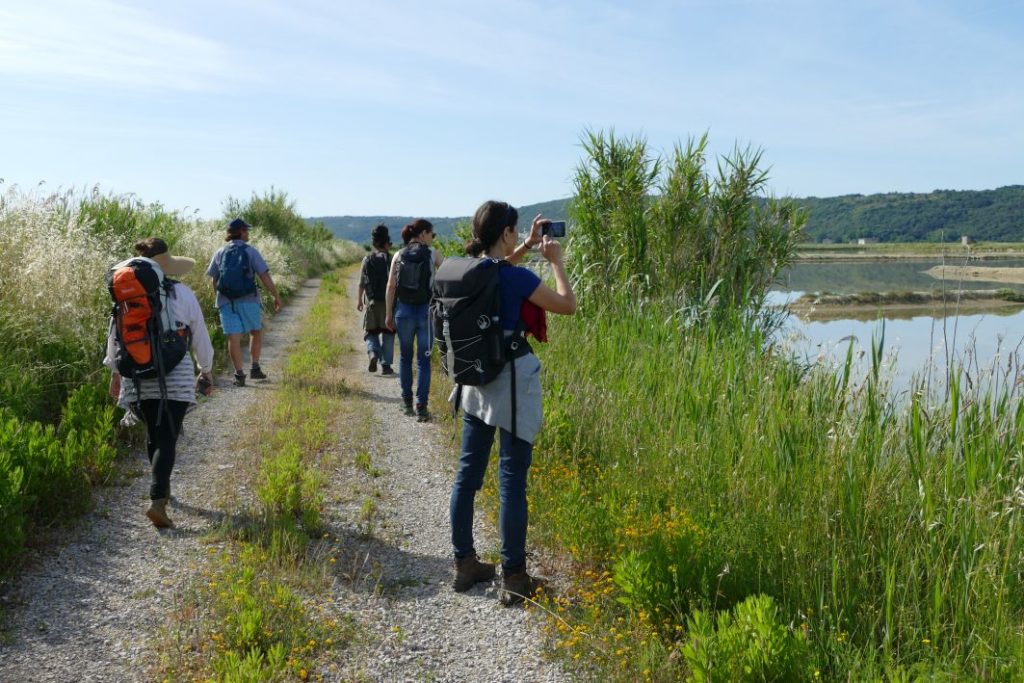
There were six participants in the walk: educator and salt worker Mitja Petronio; cultural worker, videographer, writer, and actress Hana Vodeb; and researchers Maja Bjelica and Jerneja Penca (both from ZRS Koper) as well as Nataša Rogelja Caf and Primož Pipan (both from ZRC SAZU).
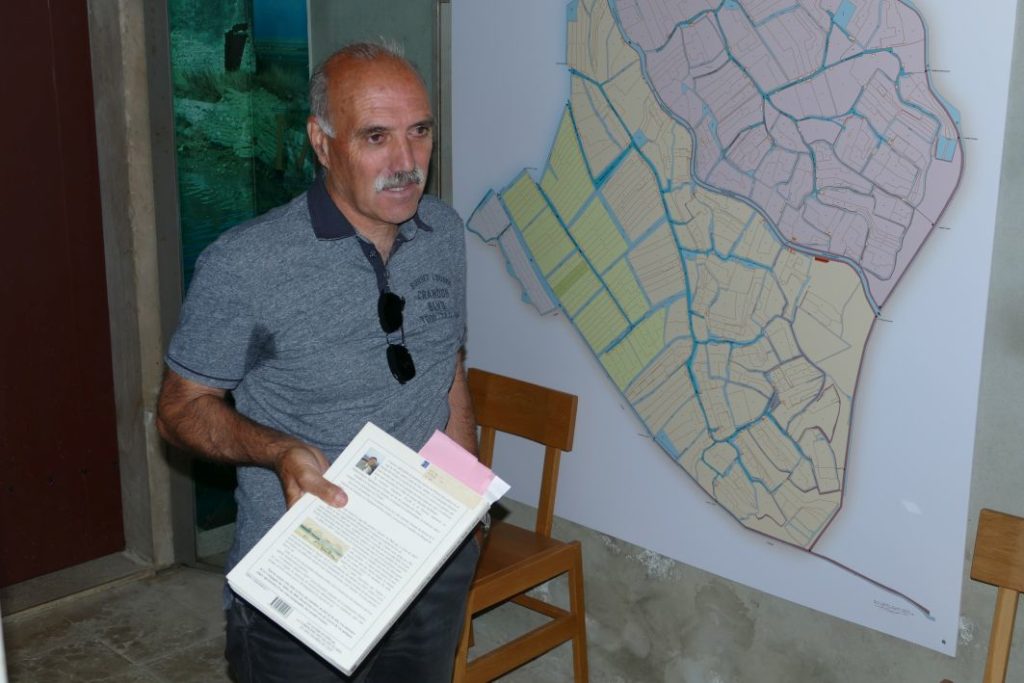
We began the first day with a walk along the embankments through the Sečovlje salterns. From the Lera area in the north of the Sečovlje Salterns, with permission from the company Soline, salt production d.o.o. and the Sečovlje Salina Nature Park, we crossed the only pedestrian bridge over the Canal Grande (Grando) or the Drnica River and arrived in the Fontanigge area in the south of the Sečovlje salterns. The bridge is intended only for employees of Soline, Salt Production ltd., so this was truly a great privilege for us. At the Museum of Saltmaking, salt worker Daniel Ivičić demonstrated the restoration of a salt embankment using salt mud from the museum’s salt collection. Flavio Bonin from the “Sergej Mašera” Maritime Museum in Piran presented the history of salt production in the Sečovlje salterns at the Museum of Salt making. We walked along the St. Odoric Canal, or the Dragonja River, to the Sečovlje border crossing, and then along the Parenzana to the entrance of the Sečovlje Salina Nature Park on Lera. Throughout the entire exploratory hike, we stopped frequently to discuss what we had seen and experienced.
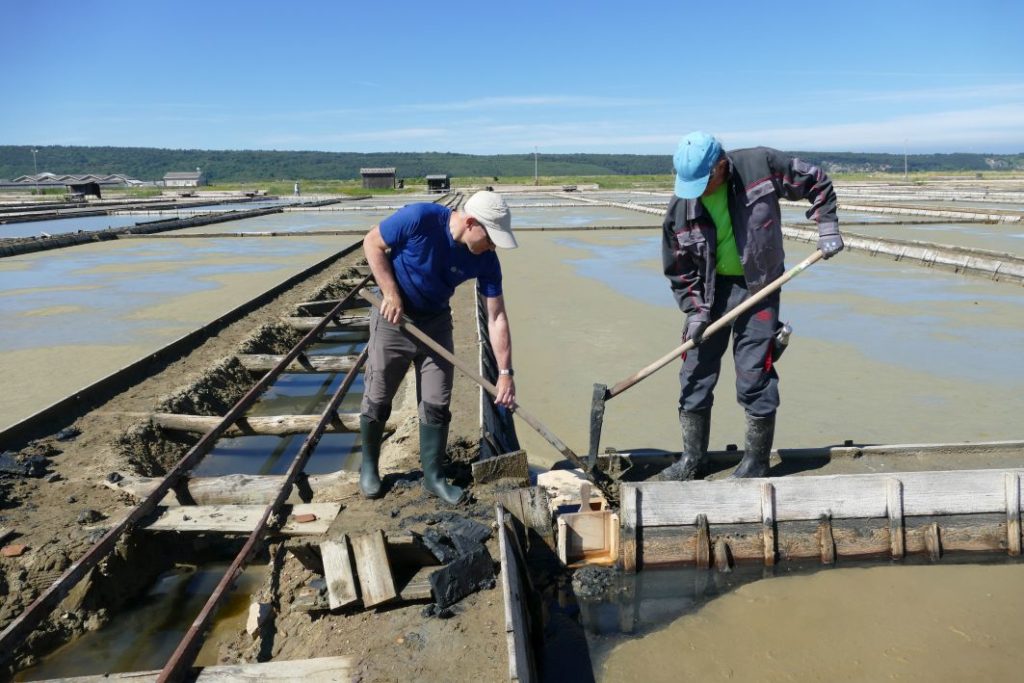
The second day of the walking seminar took place on Lera. We began with hands-on work in the salterns at salt fields N19 and N11, where, among other things, under the guidance of salt worker Matjaž Lužnik, we installed two new wooden sluice gates called kolo. The old ones were worn out and leaking. Biologist Neli Glavaš gave a lecture on petola microbial mat. At the headquarters of Soline, Salt Production Ltd., we watched the documentary film “30 Years of the Museum of Saltmaking,” which was filmed in 2021 by the “Sergej Mašera” Maritime Museum in Piran and the Institute for the Protection of Cultural Heritage of Slovenia. The screening was followed by a discussion with Aleksander Valentin, director of Soline, Salt Production Ltd., and Neža Čebron Lipovec from the Faculty of Humanities at the University of Primorska.
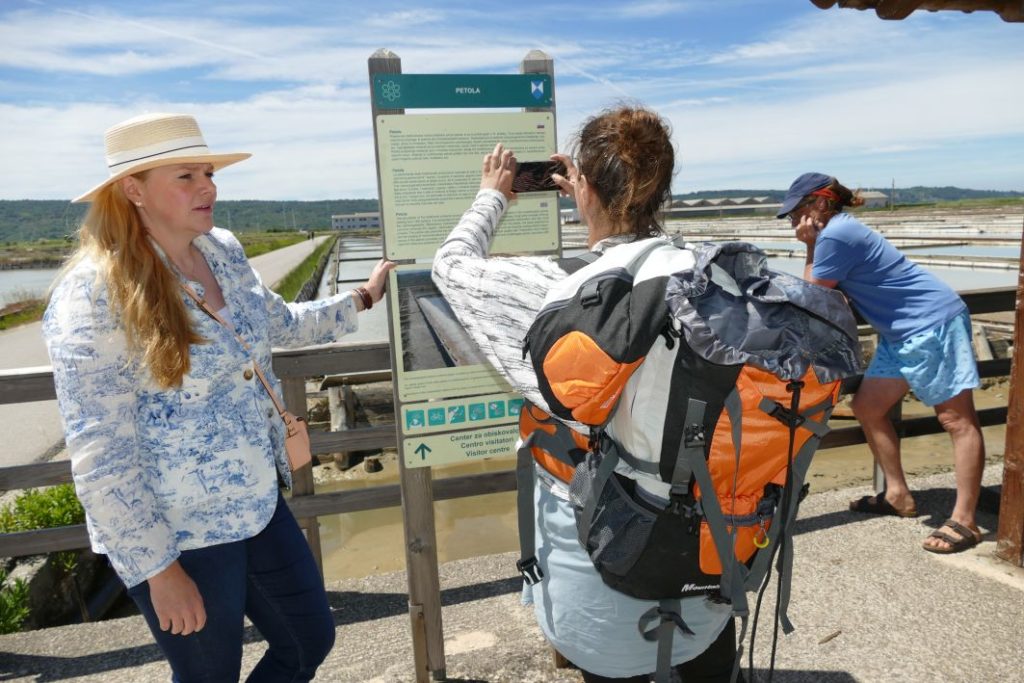
3rd walking seminar: Landscape Park Strunjan, Sečovlje Salina Nature Park, October 1–2, 2025
On October 1 and 2, 2025, the 3rd Hiking Event took place in the Landscape Park Strunjan and the Sečovlje Salina Nature Park. The question was: Who is the air? The sub-questions were: Do they breathe in the singular or plural, or perhaps in pairs? Are they hosts or spirits? Do they fly, sway, or sing? All questions were related to saltmaking, salterns, and the salt-making landscape.
There were nine participants in the walk: educator and salt worker Mitja Petronio; cultural worker, videographer, writer, and actress Hana Vodeb; salt worker Javier Betanzos from Mexico; educator Saara-Maija Strandman from Finland; and researchers Guðbjörg R. Jóhannesdóttir (Faculty of Education, Icelandic Academy of Sciences), Maja Bjelica and Petri Berndson (both from ZRS Koper), and Daša Ličen and Primož Pipan (both from ZRC SAZU).
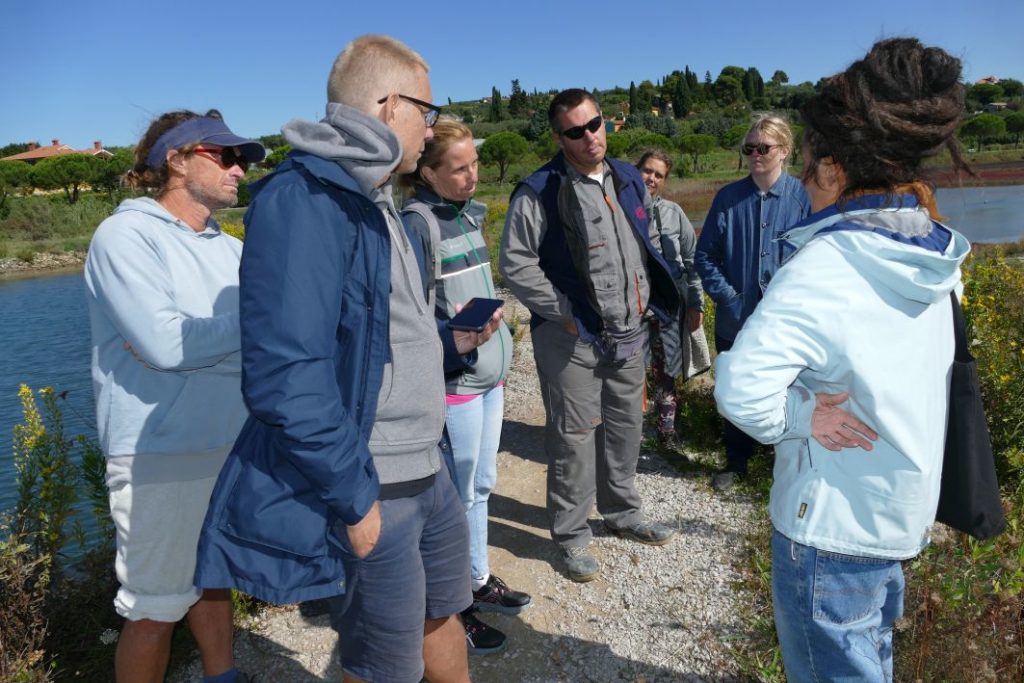
The first day was dedicated to the salterns in Strunjan. Under the guidance of Petri Berndson, they first explored respiratory philosophy in practice. Petra Škrinjar and Brina Knez from the Landscape Park Strunjan then introduced us to the geographical features of the Landscape Park Strunjan. Tomi Matković, a salt worker from the company Soline, Salt Production Ltd., presented the salt production process in these northernmost Mediterranean salterns.
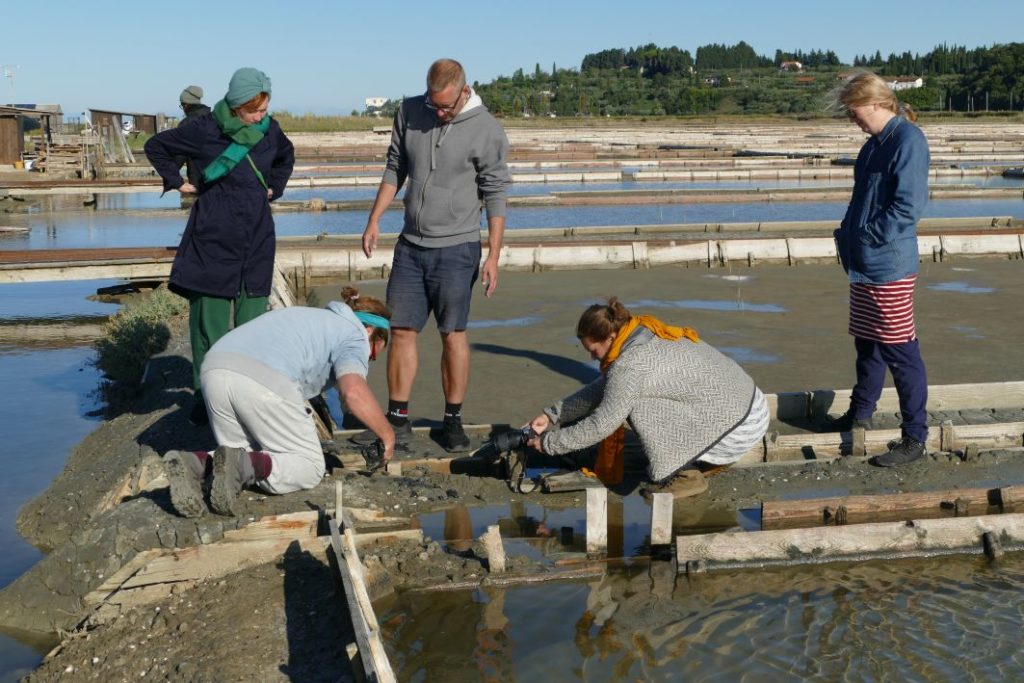
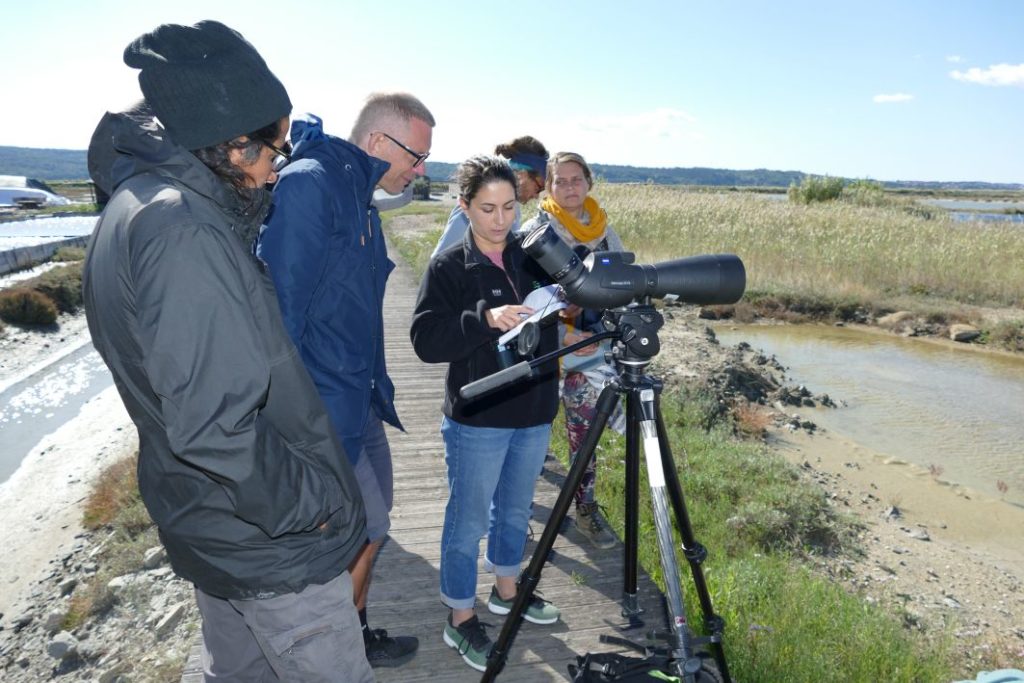
On the second day, our field site was the Sečovlje salterns. We participants in the field course focused on hands-on work in the salterns. At salt field N19 on Lera, we helped with the harvesting. We repaired damaged sections of the salt crust at the bottom of the cavedins (crystallization basins). We patched the damaged or blistered petola microbial mat with pliable mud so that it would eventually heal. Together with Mrs. Bia Rakar, the nature conservation supervisor of the Sečovlje Salina Nature Park, we observed birds in the Sečovlje Salina Nature Park. Mitja Petronio introduced us to the wind rose, which salt workers used in their work in the salterns. Associated with it is a plant that “senses the wind,” which salt workers call pajeta; its scientific name is the long-beaked erodium (Erodium ciconium). Guðbjörg R. Jóhannesdóttir guided us through a practical exercise in embodied critical thinking, specifically “focusing” (thinking at the edge). Saara-Maija Strandman, meanwhile, led us through breathing and singing exercises.
A strong bora wind accompanied us both days, so the two-day research hike was truly all about the air. Wind is a more important producer of salt than the sun. This is because the wind carries away the saturated layer of air near the ground above the cavedeni – the crystallization basins.